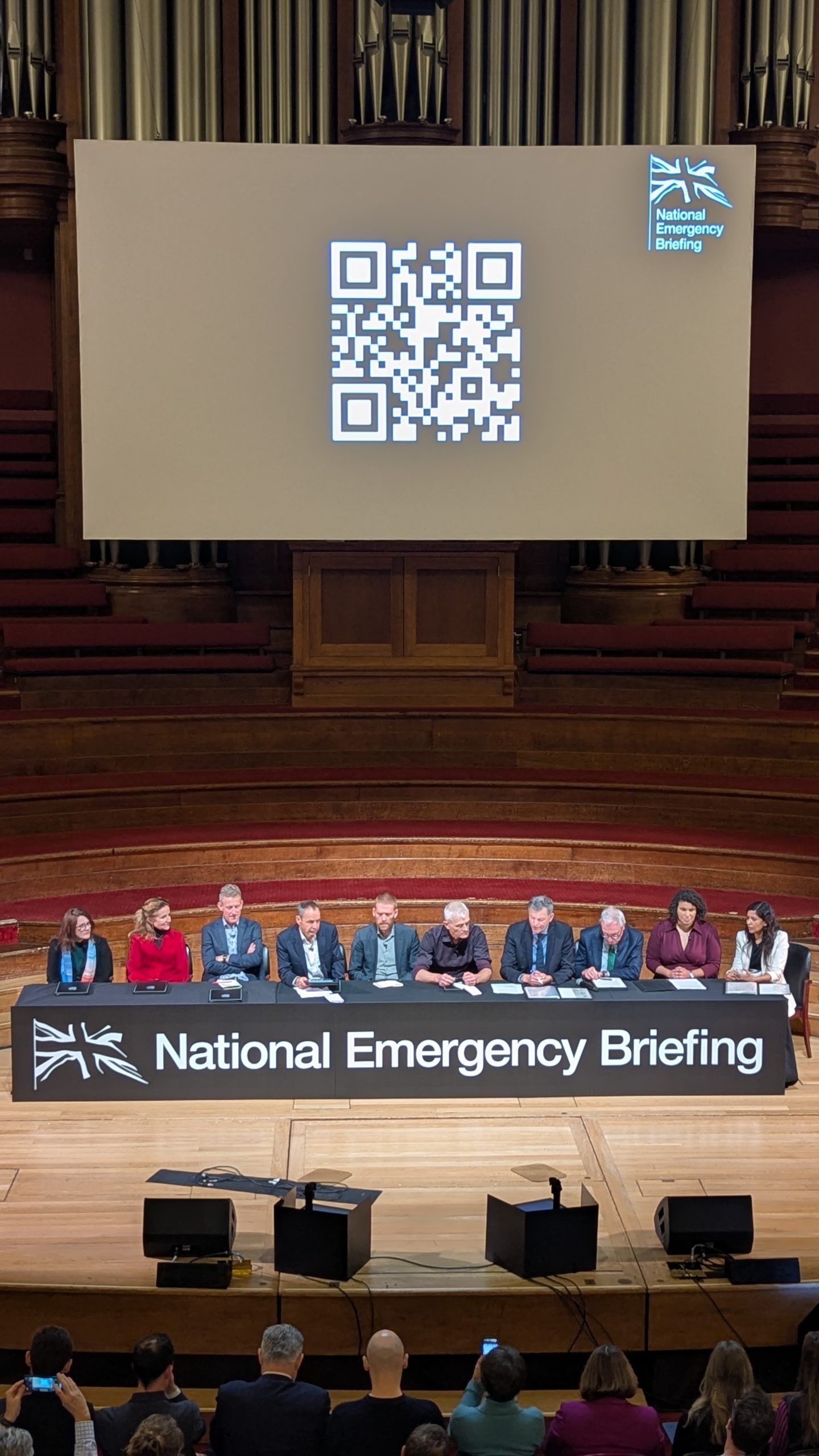
Media Revolution welcomes the ‘Letter to Sir Keir Starmer and Media Heads’ released at yesterday’s National Emergency Briefing in Westminster. The briefing was attended by over 1,200 people including around 150 Parliamentarians, senior civil servants, business leaders, faith voices, cultural and sport figures, community leaders and over 80 MPs where a call for an emergency national broadcast was made.
The event on November 27 was billed as a climate conversation reset – and Media Revolution says the conversation must now go further.
The latest scientific evidence shows that — like many other countries around the world — the UK must urgently prepare for a cascade of serious societal impacts. The accelerating climate and nature crises are set to make the UK increasingly unstable, with extreme weather, food shortages, economic shocks, infrastructure strain, and rising geopolitical risk. The briefing also made a new critical intervention. For the first time, leading scientists and public figures named the media as a central driver of the crisis — and an essential part of the response.
“Our wider media is either far from independent, outwardly biased, or simply failing in its duty to explain to everyone the gravity of our predicament,” said Chris Packham, who opened the briefing and urged public support for a letter to Tim Davie (Director General of the BBC), Carolyn McCall (Chief Executive of ITV), Jonathan Allan (Channel 4), Sarah Rose (Channel 5), Geraint Evans (S4C), and Dame Melanie Dawes, (Chief Executive of broadcast regulator, Ofcom).
The letter to Prime Minister Sir Keir Starmer, the major broadcasters, and Ofcom warns:
“We are deeply alarmed by the scale of fossil fuel–funded disinformation that has flooded Westminster and the media.
The lack of public access to accurate, science-based information has created a vacuum which has been filled by polarised headlines that deny and delay action.
“Under the Communications Act 2003, all public service broadcasters must inform the public on major national and international issues. The UK has so far failed to meet these obligations.
“We therefore ask the Government and all public service broadcasters to hold an urgent televised national emergency briefing for the public, and to run a comprehensive public engagement campaign so that everyone understands the profound risks this crisis poses to themselves and their families.”
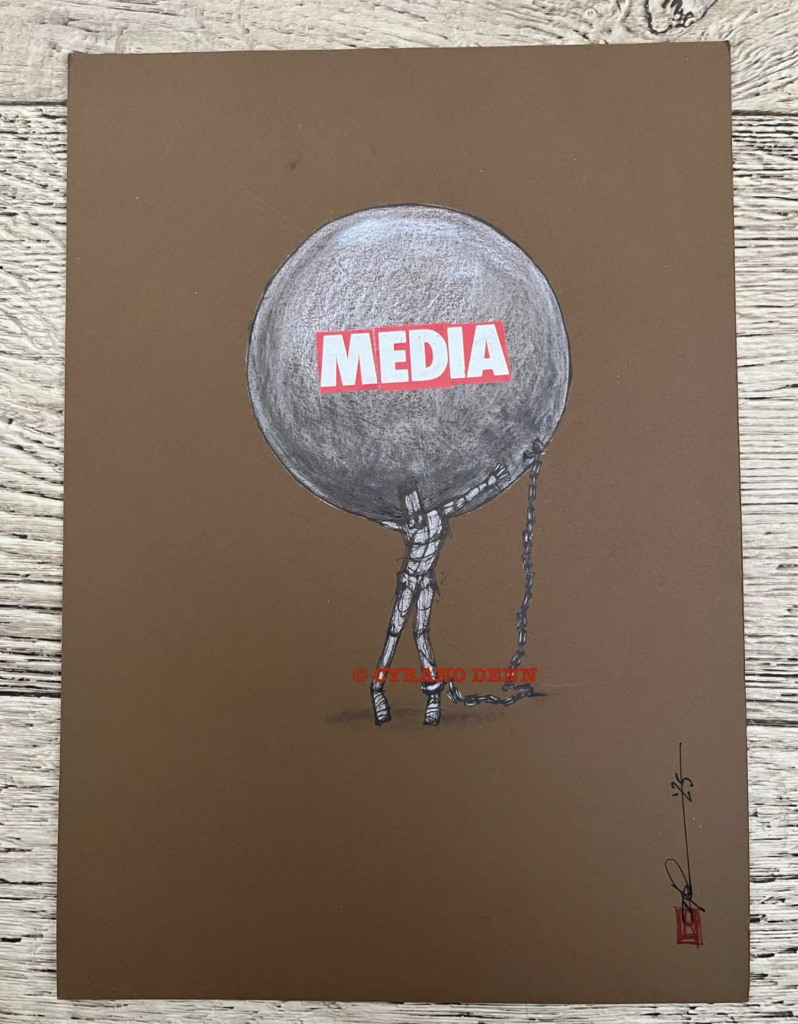
YES — broadcasters must act. Regulators must do better. AND — the media system as a whole must be transformed.
The briefing centred on media responsibility firmly. But broadcasters are only one part of the system. The most influential media actors also include newspaper groups, disinformation-led channels such as GB News, and digital platforms whose algorithms frequently amplify polarisation, disinformation and delay.
To protect the public — and to protect those in the majority world already suffering the worst impacts of crises driven by wealthy nations — the UK must use its privilege, resources, and democratic infrastructure to transform the media landscape with accuracy, not complacency. That requires all media institutions to meet the same high standards of responsibility.
“If we want everyone to understand the risks we face, every media outlet must be required to provide accurate information. Many that were not present today regularly promote cynical disinformation about the climate and nature crises, contributing to years of delay and harm,” said Tom Hardy, Media Revolution core working group member, in attendance at the briefing.
Liz Pendleton, co-founder of Media Revolution, who also attended the briefing, said: “Listening to three hours of climate science, setting out the bleakest of futures for the UK and the world, was harrowing. The media are failing in their responsibility to report on this — and every day that passes where they don’t sort it out makes the emergency worse. People have a right to this information so we can make informed choices, but the media are gatekeeping. As media consumers, we must unite to defend our rights — and we must take action.”
Caspar Hughes, co-founder of Media Revolution, “Until we tackle the hugely powerful billionaire corporate media owners, the climate and nature crises will worsen, and our descent into fascism will accelerate. The short legacy we will leave our children is a rapidly destabilising and increasingly uninhabitable planet riddled with violent conflict. The first step to changing the future and giving our children a chance at a more peaceful future is to change the media.”
Yesterday’s briefing represents a watershed moment — the point at which leading experts finally said openly that the UK cannot protect its people, or play its global role, while its media system continues to obstruct public understanding. Misrepresentation and manufactured division are not limited to climate: the same media ecosystem has fuelled support for escalating wars, polarisation of communities, mindless consumption, and contributed to widespread anxiety and depression.
Other speakers at the briefing included: Professor Nathalie Seddon (nature crisis), Professor Hayley Fowler (extreme weather), Professor Hugh Montgomery OBE (health impacts), Lt General Richard Nugee CB CVO CBE (national security), and Angela Francis (economic transformation).
It’s clear that the Government and broadcasters must now work together with absolute urgency. And this must be only the beginning of a wider effort to ensure the whole UK and global media system meets basic standards of accuracy and public protection for people and planet.
You can support the call for an emergency broadcast by signing the public letter here:
https://docs.google.com/forms/d/e/1FAIpQLScbdkcuPaw_Rz-CW8rqrXuBmLHMW5hNZ2juqpgjYsF_cxIXbg/viewform?pli=1
And you can join Touch Paper – media consumer union here: touchpaper.media
ENDS
Media contacts:
Liz Pendleton — Media Revolution — 07779341156
Caspar Hughes — Media Revolution — 07747041596