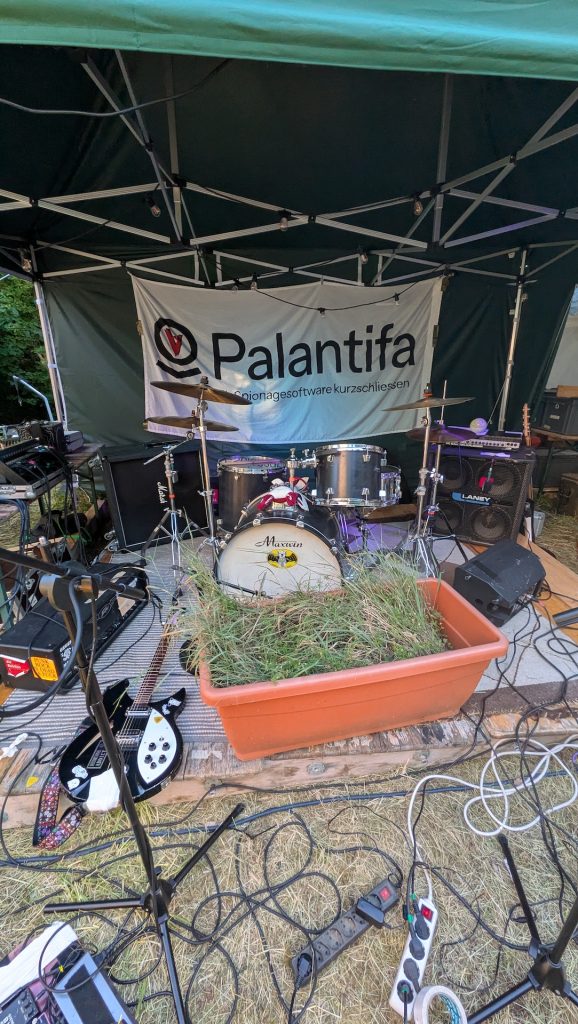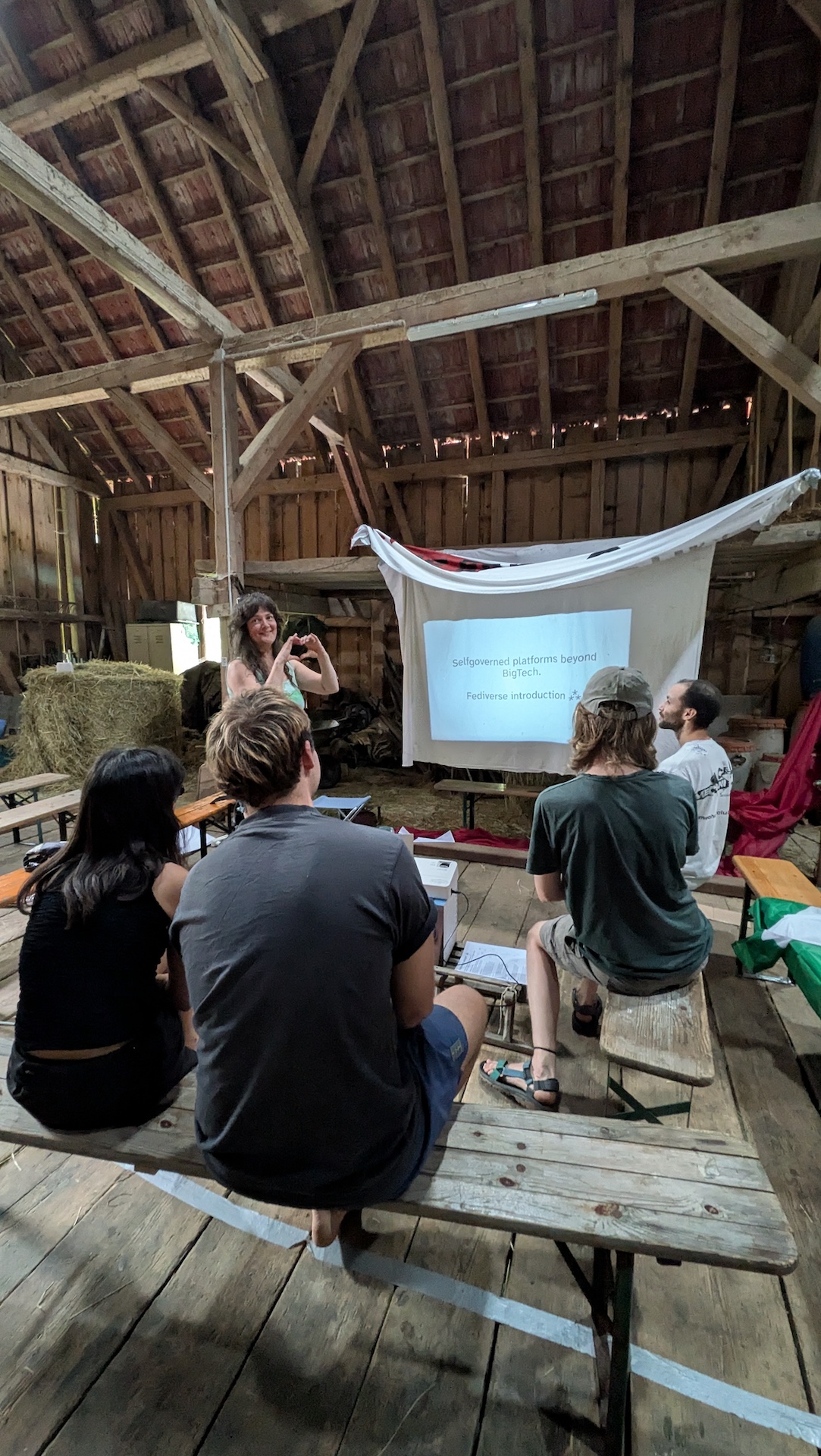
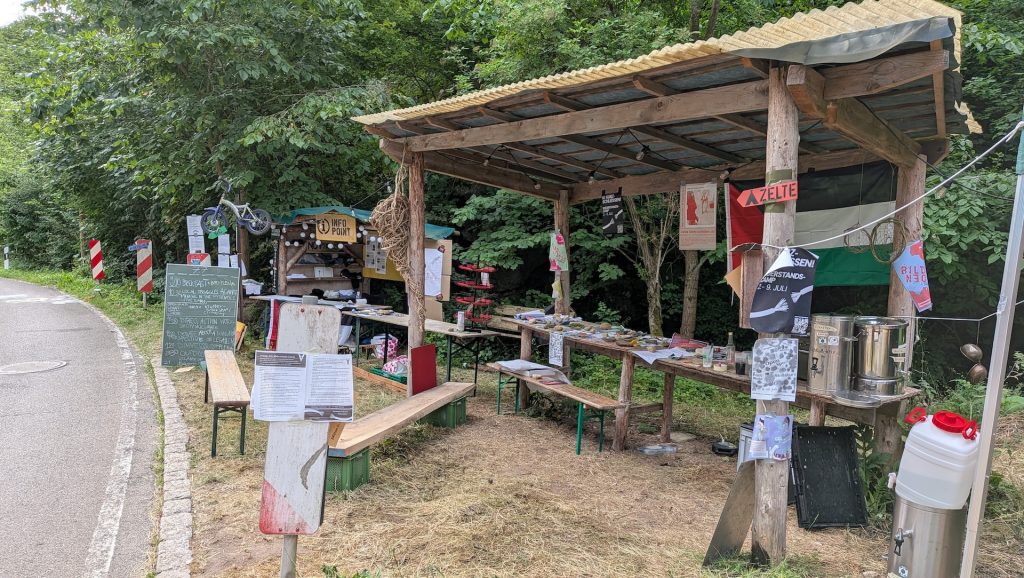
The “KI kurzschliessen” – AI Short-Circuit Protest Camp – was organised by Aufstaende der Allmende (Uprising of the Commons) to take place in the Schaffhausen region in Switzerland – a hot spot of the ongoing massive expansion of AI infrastructure, such as data centres.
“Switzerland is seeing a growing number of data centers being built. Precise figures are unavailable, but estimates suggest there are around 120 data centers”. https://www.20min.ch/story/aufstaende-der-allmende-schweizer-ki-gegner-veranstalten-protestcamp-gegen-datenzentren-103594934
On day two of the camp, according to organisers, “a massive violent attack by the police” meant the camp was dismantled and relocated to neighbouring Germany, close to the Swiss border in Tengen.
“We are a grassroots democratic and revolutionary organization from German-speaking Switzerland. We have a tactical focus on direct action against the organization, logistics and infrastructure of the ruling class on the one hand– and the other, solidarity-based forms of organization. On the other hand, we want to contribute our part to the global social revolutionary movement against capitalism and colonialism –because the Earth and the lives of all of us depend on it.” their website states.
The group first appeared in 2025 when they planted a construction site on a motorway and occupied a forest in Bern to protest against a road project, and are now turning their attention to AI.
On one hand, the “AI situation” may seem complicated.
This ‘tech’ appears to save time, help with medical research, and makes mundane admin tasks simple and fast. It never gets tired, it will chunter away at your least-favourite work with a friendly (if sycophantic) demeanour, and is always ready to help, a new sort of confident at your fingertips.
It is being hailed as the industrial revolution 4.0.
But on the other hand, there’s a pretty long list of nightmarishly unethical issues.
Including, but not limited to, the evidence that AI:
- Makes users more stupid, with cognitive offloading
- Induces AI psychosis
- Replaces humans in the workplace
- Falsifies information – generates fake pictures and hallucinated news –
- Creates ‘Phantom case law’ in legal cases
- Changes who controls knowledge itself – (including plans to sell it back to us)
- Fakes medical information
- Operates autonomous weapons such as Ai drones which kill civilians, in direct contradiction to the Geneva convention
- Provides suicide advice to teenagers
- Weaponizes surveillance technology to influence behavior at scale
But perhaps the clearest issue is the devastating impact on the planet.
The runaway data centre construction – using vast swathes of land, polluting the air, and guzzling up water and energy – https://www.lse.ac.uk/granthaminstitute/explainers/what-direct-risks-does-ai-pose-to-the-climate-and-environment/ is simple to understand.
Our planet – and we – simply cannot afford it.
Our resources are scarce and we need to treat them as such, not squander them on computational ‘conveniences’.
The hypernormalisation of AI and AI hype in the media means that not only are the key facts about the damage of AI being ignored, AI itself is also polluting the media landscape.
After sucking up all of the known knowledge created by humans (without a care for intellectual property) – and rewriting news article headlines by journalists along the way – it then degrades the information on the internet with dangerous inaccuracies disinformation and AI slop – making the media landscape even harder to navigate, let alone trust. And worse, it algorithmically boosts more billionaire bullshit.
When we say ‘Media’ in Media Revolution we include AI in the ‘media’. From the legacy of the printed press, through to the addictive design of social media and now to the algorithms of destruction and AI; these battles are not separate. They centre around brainwashing by billionaires – otherwise known as menticide. The menticide to judge each other and ourselves, consume as if there’s no limits, disconnect and divide.
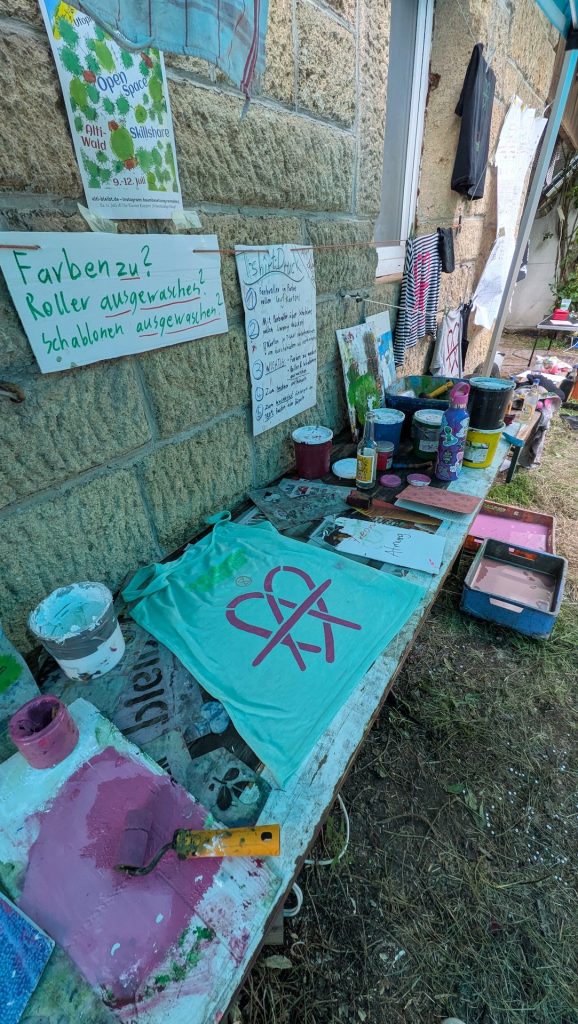
Media Revolution was invited to hold a workshop as part of the camp, focusing on responses to the media & AI enshittification. Travelling by rail and bus, co-founder Liz Pendleton made the journey and spent two days in the camp.
“The solidarity, care and connection was incredible. Daily plenaries were held to share out the tasks of running the camp, such as cooking the vegan food and running the workshops and talks – it ran like a temporary community, something akin to the commons. Translation available for the various attendees from different parts of Europe, the organisation was excellent.”
“It’s clear that community connection is a real antidote to AI – the coordination and strengthening of bonds, including those with the UK where data centres of 800 acres are planned in biodiverse Devon, is essential. People power and disruptive tactics are essential for change on the scale and timescale we need it – as is a genuine Media Revolution.”
And there is a response, in fact there are hundreds. The Media Revolution responses are all linked to the very critical sentiment of the Aufstaende der Allmende /ADA (Uprising of the Commons) camp. Activities include forming a network of News Clubs designed to increase media literacy and community connection, launching a media consumer union to coordinate boycotts against problematic publishers and platforms, growing Mo-Me the decentralised social network with no ads or algorithms – and the keystone activity, uniting movements to coordinate for a movement media together.
Movement media is accurate, independent, well regulated, and seeks to inform the public on key matters which affect our lives, rather than the malignant media which seeks to distract and divide us.
However, pushback against AI is not limited solely to organised activism. According to a recent study by the Digital Futures Institute at King’s College London and Responsible AI UK, over 40% of adults surveyed in the UK intentionally restrict their AI usage in their daily lives. Around 52% believed that AI carried more risks than benefits.
“I wish I could share more photos or videos of the camp” said Liz, “or describe the deep sense of respect, love and care I felt from people there. But understandably a ‘no photos of people’ rule was in place to protect the anonymity of attendees.”
“However, what I can say for sure is that spending time together, camped by a stream in a forest, seeking protection of our beautiful planet and each other, has furthered the deep connections between resistance collectives in Europe and the UK. We’re stronger and have more potential now. I’d like to thank Aufstaende der Allmende for the invitation. I’m looking forward to working together and making plans towards Media Liberation Day on November 5th with the many different groups and collectives connected to the camp.”