Author: Philippa Davies

  • Finding The ‘Sweet Spot’ Between Investigation and Activism

    Finding The ‘Sweet Spot’ Between Investigation and Activism

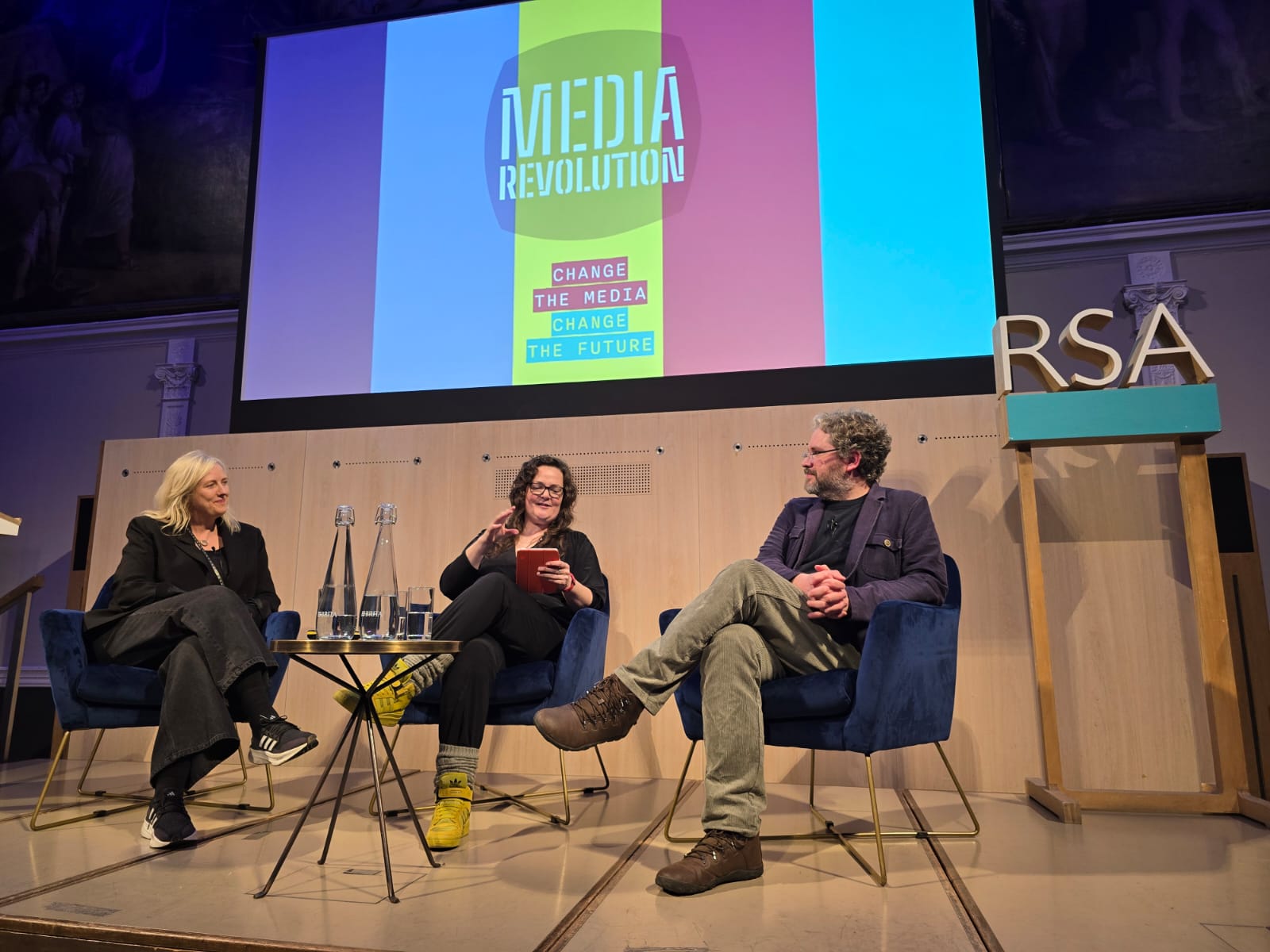
    At Media Revolution’s public ‘Disinformation and Democracy’ event at the Royal Society of Arts (RSA) in London, two legends of investigative journalism shared their insights into the omnicrisis and their views on the way forward.

    Carole Cadwalladr is best known for exposing the Facebook-Cambridge Analytica scandal of illegal data harvesting and election interference, and for her continuing investigations into the powerful machinations of US tech bros and their UK co-conspirators.

    Eliot Higgins is the founder of Bellingcat, which uses open-source investigation to produce actionable intelligence on issues of public concern all over the world, revealing massive cover-ups and corruption by governments and state powers.

    The hour-long debate on Thursday, February 26,, chaired by Media Revolution co-founder Liz Pendleton in front of a full house, could only scratch the surface of a complex mesh of issues. But it did demonstrate that Media Revolution’s work is motivated by the same principles as those of our two speakers: the need to combat multiple threats to democracy and humanity. Many of Media Revolution’s ongoing activities align with Bellingcat’s roadmap for ‘bending the arc of history back towards truth, participation and justice’.

    The Omnicrisis

    This is an era of what Carole Cadwalladr described as ‘total information collapse’ in which the mainstream news media are failing to present a narrative that makes sense to people. She talked about ‘performative accountability’ in which, even when wrongdoing is reported and inquiries are held, nothing actually changes. The lack of any real action against Facebook in the wake of Carole’s internationally-reported investigations is a case in point.

    She and Eliot Higgins both recognise that the public distrust of institutions is often justified by people’s personal experience –and that by association, many see the ‘legacy’ media as part of the problem. Naturally, people have turned to online content creators who, Carole said, “are humanising what’s happening and filtering it through their own personalities” – appearing relatable, credible and trustworthy.

    But we know social media is a minefield for information – as summed up by Bellingcat:

    Bellingcat summarises the challenge ahead as: “This is not just about fighting disinformation, it’s about reconstructing the systems, values and capacities through which people can reason, act and hold power to account – the conditions for a living democracy”.

    Its ‘Arc framework’ for achieving this is grounded in the principles of verification (collective commitment to truth and evidence), deliberation (collective reasoning to solve problems and guide action), and accountability.

    The framework comprises eight separate but inter-related ‘tracks for democratic renewal’, including education, civic empowerment, the rebuilding of shared values, and actions to restore evidence-based accountability to systems of governance.

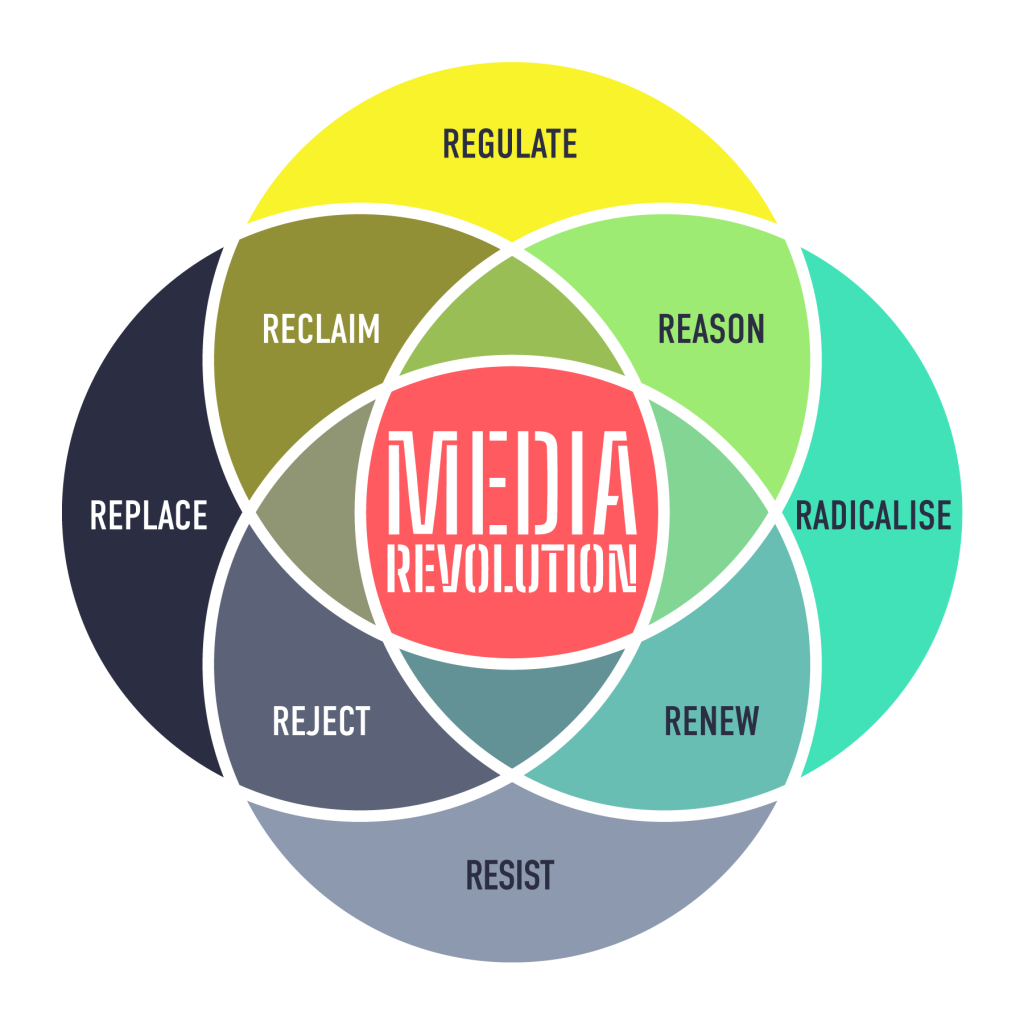
    Spot the similarities with Media Revolution’s intersectional Venn diagram, in which the eight areas of activity each have a different focus, but represent a collaborative approach to multiple, inter-related issues.
    Empowerment through investigation

    Within Bellingcat’s framework, the process of investigation is an exercise that flexes and strengthens the democratic muscle. Alongside its own deep delves into institutional wrongdoing, Bellingcat is actively equipping organisations with the tools and knowledge to do this for themselves – often at grassroots level. This has included student-led investigations resulting in reforms to council transparency, and community organisations using their findings as evidence in campaigns to bring about change.

    Media Revolution recognises that access to reliable and accurate info is a human right intrinsic to democracy, and our work feeds into the same process. Media literacy activities including News Clubs empower people to become active, informed and critical consumers of news media rather than passive, overwhelmed recipients. They equip people to challenge disinformation and find sources of factual evidence to back up calls for action. 

    The creation of the media consumers’ union Touchpaper will do this on a larger scale, enabling the public to take collective action – including boycotts – against publishers and channels.

    On the issue of restoring values and trustworthiness to media organisations, Media Revolution is collaborating with Hacked Off, the media reform campaign, and the independent regulator Impress, to campaign for effective press regulation in the UK and real powers to hold owners and publishers to account. The lack of follow-up to the Leveson Inquiry into phone-hacking and other media malpractice was yet another missed (or evaded) opportunity for investigation to bring about change.

    Where do we go from here?

    Although there wasn’t time during the RSA event to explore the details of Bellingcat’s Arc framework, the debate did shine a light on the way ahead.

    The discussions confirmed that Media Revolution’s response to the information crisis tallies with Carole Cadwalladr’s experiences of deep-dive investigation – and our actions already align with Bellingcat’s plan of action. Media Revolution will continue to work with the  Bellingcat framework, and with any luck we’ll stage a follow-up event, either at the RSA or somewhere else to continue the conversation with the public.

    The  debate also highlighted the fact that, in today’s malfunctioning media and information system, the quest for verification, deliberation and accountability is a form of activism. Refusing to accept the defeatist line about a ‘post-truth era’, developing skills to root out evidence, and sharing those tools and resources widely so that hidden facts can become public knowledge – this is an expression of rebellion as well as an exercise in democracy.

    And finally ….

    As the discussion drew to a close, a pivot point was unwittingly provided by an aggressive, attention seeking heckler who interrupted Carole as she talked about her own values as a journalist. Rather than submitting a live question for debate, he shouted: “Activism isn’t objectivity, Carole,” and accused her of ‘inappropriate bias’.

    It’s significant that the heckler didn’t claim Carole’s investigations were flawed, or that their findings were inaccurate. And if he was suggesting that journalists shouldn’t be politically motivated, that would disqualify most national newspaper editors – not to mention their star columnists – from doing their jobs. Let’s not even start on GB News.

    In fact, the interruption was more redolent of online trolling – an ad hominem attack, which, if launched into a febrile social media debate, would fire up the algorithms and escalate into the usual frenzied hate-fest.

    At the RSA, though, it wasn’t going to land.

    Instead, Carole calmly explained: “Trust comes from transparency and accountability … my bias is towards the truth, and it is towards democracy, and it is towards democratic accountability, and all of my journalism is based on those fundamental principles.”

    It brought us neatly back to the mainstay of Bellingcat’s Arc framework: a commitment to verifiable evidence from clearly indicated sources, with the aim of increasing understanding, not performing, simulating or optimising an online audience.

    It was also a reminder that active resistance to corruption and disinformation must live up to the standards it’s campaigning for. Activism must remain transparent and accountable.

    ——

    Philippa Davies is an independent journalist, and part of the Core Working Group at Media Revolution.


    You can also read a ‘behind the scenes’ account of the event by event chair, Liz Pendleton, here.

  • Is this a tipping point for social media?

    Is this a tipping point for social media?

    Deliberately and knowingly causing harm to children – as a business model.

    It’s not a good look for the social media giants Meta and Google, who are currently on trial in the US over claims that they intentionally created ‘addiction machines’ to maximise their profits – ignoring warnings about the risks to young people’s wellbeing.

    The case is the first of dozens that have been filed against Meta in the US, holding the company responsible for a crisis in youth mental health.

    The pressure is stacking up, and it’s about time. In Europe, France, Denmark, Greece, Austria, and Portugal are moving towards a ban on social media access for children and young teenagers, following Australia’s landmark ban in December. Other countries, including the UK, are consulting on similar age restrictions.

    Spain’s proposals also include holding platform executives legally liable for failing to remove illegal content, and making it a criminal offence to manipulate algorithms and amplify harmful posts. 

    Prime Minister Pedro Sanchez said: “ We must speak clearly about the management of platforms such as X and the vision of figures like Elon Musk.

    Meanwhile, large numbers of X users have closed their accounts, after Elon Musk’s bizarre decision to incorporate non-consensual porn into his platform’s offerings.  A new YouGov survey across Germany, France, Spain, Italy, and Poland has found that 47% of Europeans would back banning X from the EU if it continues to breach EU rules.

    It’s all about the intention

    Social media companies have always ducked responsibility for user-generated content (UGC).

    But recent events have shifted the focus to what the owners of the platforms control themselves, and the decisions that they – willingly and knowingly – inflict upon their users.

    The issues that have drawn public attention in recent weeks are a very small part of the picture, but could this be  the crack that lets the light in?

    When you recognise that the incredible harm being done is not incidental but intentional, you can widen the focus, seeing the many other social media damages that can be traced straight back to the owners who control the platforms.

    For instance, amplifying posts pushing extremist political views, inciting violent hatred and shutting down rational discussion.

    Flooding the zone with AI-generated images and clickbait disinformation, as a deliberate distraction from what people can see around them in their real lives.

    Deliberately suppressing or misrepresenting the facts about the climate emergency, depriving people of the information they need to demand action.

    Using “cyborg” accounts, where a human controls the account but automation handles posting, liking, following, or replies. These are often used to exaggerate a  political groundswell or to boost specific individuals. For example, they were used to amplify right-wing extremist Nick Fuentes on X to the point that mainstream media treated him as a serious figure.

    There’s an agenda here, and it goes way beyond the damage to young people’s minds.

    Age restrictions are not the answer

    Media Revolution welcomes the high-profile debate about mental damage caused by social media platforms – and the dubious motives of their owners. It’s long overdue.

    But one thing is generally missing from the conversation: the fact that there are alternatives to X, Meta, Instagram, TikTok and the other big tech companies.

    Instead of simply putting an age limit on social media access – which helps a small group of users, but does nothing to protect others outside that age group – we can also take part in tech walkouts and guide people towards alternative platforms such as Mo-Me, which is not owned by any individual organisation, and isn’t built to prioritise addictive algorithms.

    News feeds on Mo-Me are provided by independent, regulated media organisations, and users choose which accounts and channels to follow. There are no adverts, and no profit-driven ‘pushing’ of content; it’s a safe space for people of any age who want to connect with others, receiving and sharing news and information.

    And if we’re talking about news….

    While social media is under scrutiny, this is an opportunity for governments to look at some of the most prominent and prolific sources of online disinformation: their own national newspapers and TV channels.

    At the moment, some of these newspapers and their social media channels are not only complicit in spreading hate speech and disinformation – they’re responsible.  If we’re going to talk about harms, and examine the motives of big-tech platform owners, we also need to focus on the powerful media magnates who push the same agenda.

    Let’s build on this momentum

    The US lawsuits piling up against the social media platforms, the moves towards age-restricted access and the backlash against Elon Musk’s Grokepdia and X have highlighted some of the issues that are central to Media Revolution’s work.

    This is a chance for the Media Revolution to continue growing, in momentum, in volunteers, allies and supporters. To show the bigger picture and build public awareness of what’s possible – what a Media Revolution – a collaboration of responses to the situation can truly achieve. 

    WHAT NEXT?

    Be part of a Media Revolution. Join for an upcoming event:

    Tuesday 24th FebNext News Clubs Zoom session

    Thursday 26th Feb – RSADisinformation & Democracy

    Join our Signal group – or sign up to the newsletter

  • Why Penguins?

    Why Penguins?

    Media Revolution activists in penguin costumes at the Daily Mail HQ in London

    Penguins aren’t the most obvious symbol of resistance against media corruption – but they’ve become a powerful motif.

    The story of how this came about exemplifies the spirit and humour of protesters standing up against an authoritarian state.

    In May 2013 a wave of demonstrations, strikes and civil unrest flared up in Turkey, which all began when police used tear gas and water cannon to break up a peaceful sit-in opposing the redevelopment of Istanbul’s Gezi Park. 

    Over the next few days, anger at the disproportionate police violence  snowballed into large-scale protests against the government’s attacks on civil liberties. As well as a growing activist rebellion in Istanbul, there were marches and occupations in the capital, Ankara, and many other Turkish cities. News of the uprising was reported around the world.

    But on June 2, as the international broadcaster CNN screened live footage of police clashing with demonstrators in Istanbul,  its Turkish partner, CNN Turk, decided to broadcast a wildlife documentary about penguins instead.

    This was a bit of an own goal for the national TV station, as ‘Penguen’ was the name of a popular satirical magazine in Turkey, often penalised for poking fun at prime minister Erdogan.

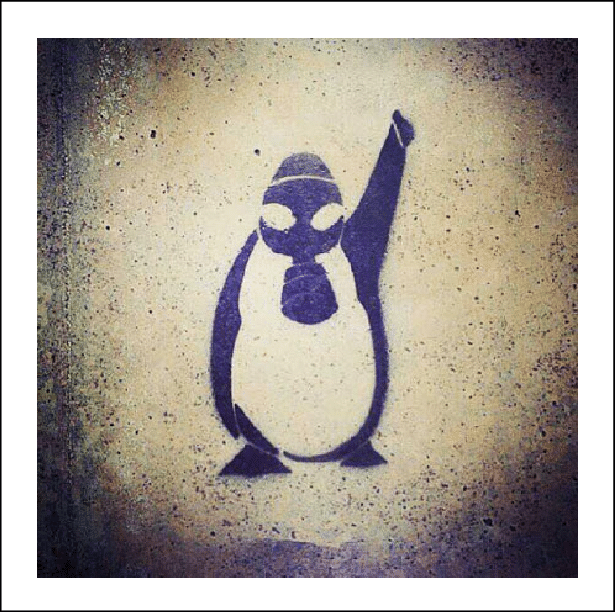
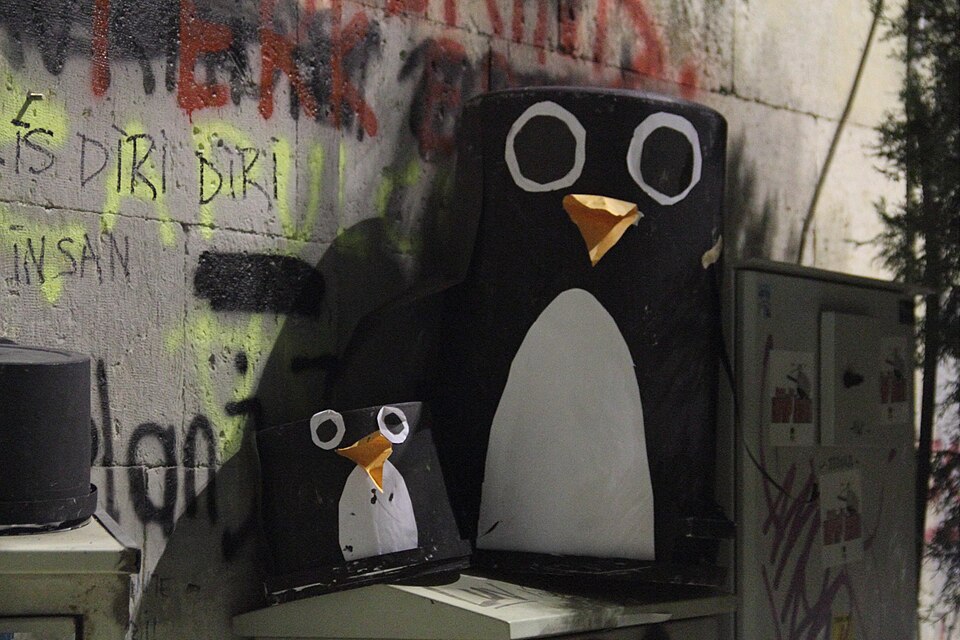
    The protest movement immediately picked up the penguin motif as an ironic visual emblem representing (and ridiculing) both media self-censorship and government influence over news coverage. Graffiti images of penguins in gas masks began appearing, penguin cartoons and memes went viral on social media,  and demonstrators started wearing penguin masks or T-shirts with the slogan ‘We are all penguins’. 

    Street art in Istanbul – stencilled graffiti of penguin wearing gas mask – image widely circulated on social media

    The news blackout also backfired, as everyone knew about the protests, and it was obvious that the TV, radio and most newspapers were deliberately ignoring them.  By failing to cover the anti-government uprising (which was everywhere on social media), Turkey’s mainstream press and broadcasters lost credibility and public trust – and spurred on more people to join the rebellion.

    Penguin effigies at Gezi Park, Istanbul, June 2013. Photo: Wikimedia Commons https://creativecommons.org/licenses/by-sa/2.0/deed.en

    Ever since the Gezi Park incident and its aftermath, the penguin has been a satirical symbol of government control over media coverage in Turkey. When TV and newspapers turn a blind eye to potentially damaging stories about the government, covering trivial or irrelevant news instead, this is known as ‘penguinisation’.

    And this is why Media Revolution activists have dressed up in penguin costumes for video stunts to mark Media Liberation Day and the beginning of a new Media Consumer Union – Touch Paper – and social network ‘Mo-Me’. Well, it’s also partly because penguins are distinctive, quirky, comical and also very cool. But mainly because the Turkish media cover-up over Gezi Park has so many equivalents in today’s global press, broadcast and online channels; the public are being routinely kept in the dark about vital information, lied to for political purposes, and distracted by PR froth,celebrity trivia and fake AI-generated propaganda masquerading as ‘news’.

    Media Revolution takes inspiration and impetus from the way the Turkish protesters seized upon that first incident of ‘penguinisation’, flipped the script and used it to ridicule the government-compliant media. They turned the penguin into a symbol of resistance and  resilience, representing the power of real news and communication when it’s freed from political spin and corporate influence.

    Today, we are all penguins.