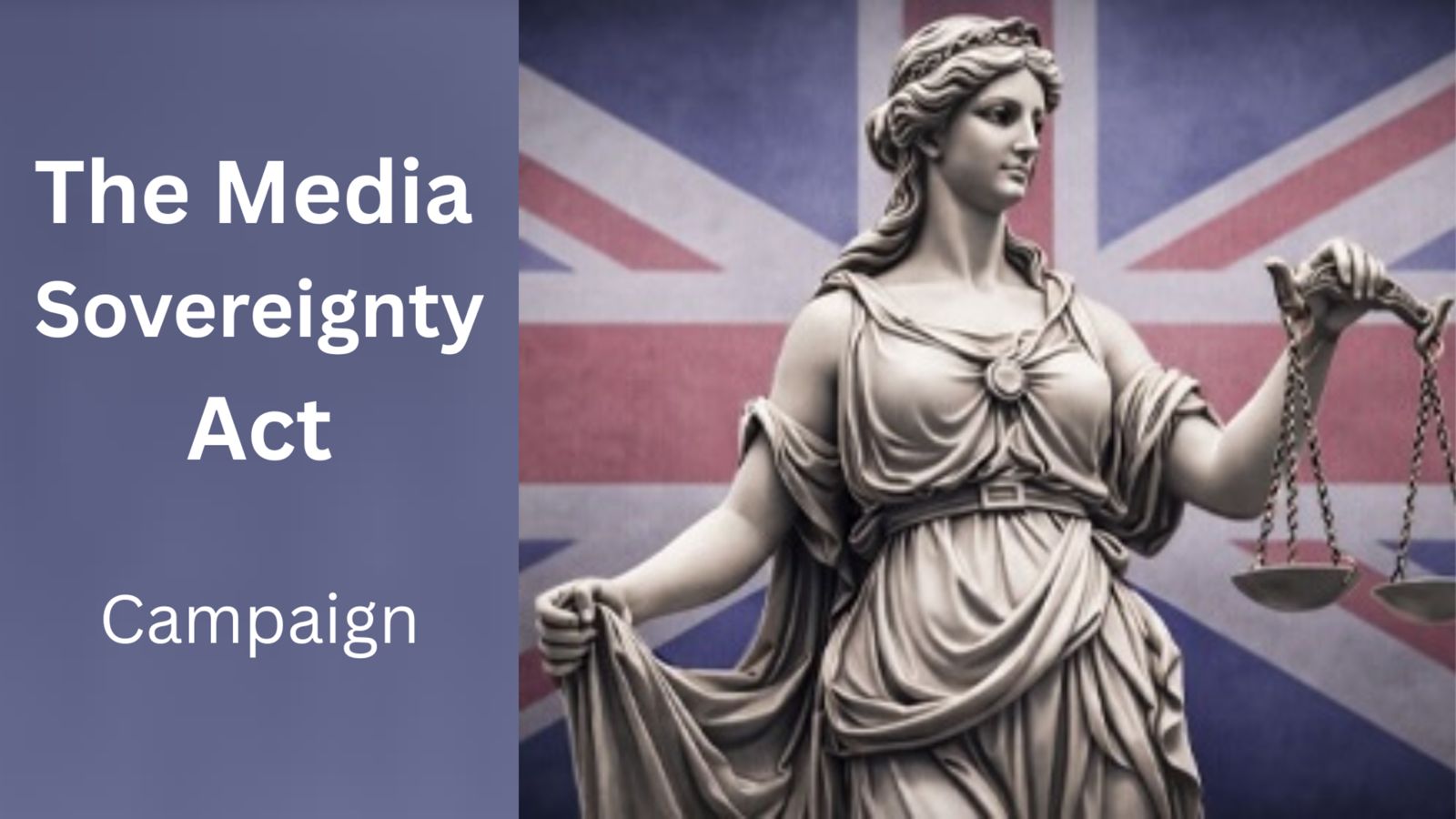
This campaign aims to get the Media Sovereignty Act passed by the UK Parliament.
It proposes the radical reclamation of sovereignty over the ownership of Britain’s media from the international and national billionaire elite that have hijacked it for their narrow, undemocratic, destructive agendas.
In other words, a radical and positive revolution in media ownership! A sovereign-owned media is essential for a genuinely free people and a fair, thriving democracy for everybody in the United Kingdom.
Friends of the Earth Birmingham UK joined Media Revolution in February 2026.
From their website: “The Warehouse is Birmingham Friends of the Earth’s environmental community building which is a space for activism and a home to our campaigns activity, meeting space, the vegan Warehouse Cafe, Voce Books and Sprocket Cycles. We also have office spaces which are used by organisations that share our values.
A recent refurbishment has transformed and increased our space, made it much more accessible and helped us save energy. We want it to continue and grow as a place where people can meet to make environmental and social change happen.
Recently we have joined the Climate Emergency Centres network, and are working to improve our role as a home for all Birmingham’s diverse communities of green activist to work together, be inspired and strengthened.
Friends of the Earth have put together some incredible myth-busting resources we’ve just published today and a more in-depth series of pieces, directly addressing real examples of disinformation spread by Reform UK and other right-wing politicians.
On 27th November, ten of the UK’s leading experts in climate, health, food, national security and the economy briefed an invited audience of over 1,200 politicians and leaders from business, culture, faith, sport and the media.
The day ended with a call for the Government to deliver a prime-time, multi-channel televised national emergency briefing to the nation, launching a major public engagement plan to cut through disinformation.
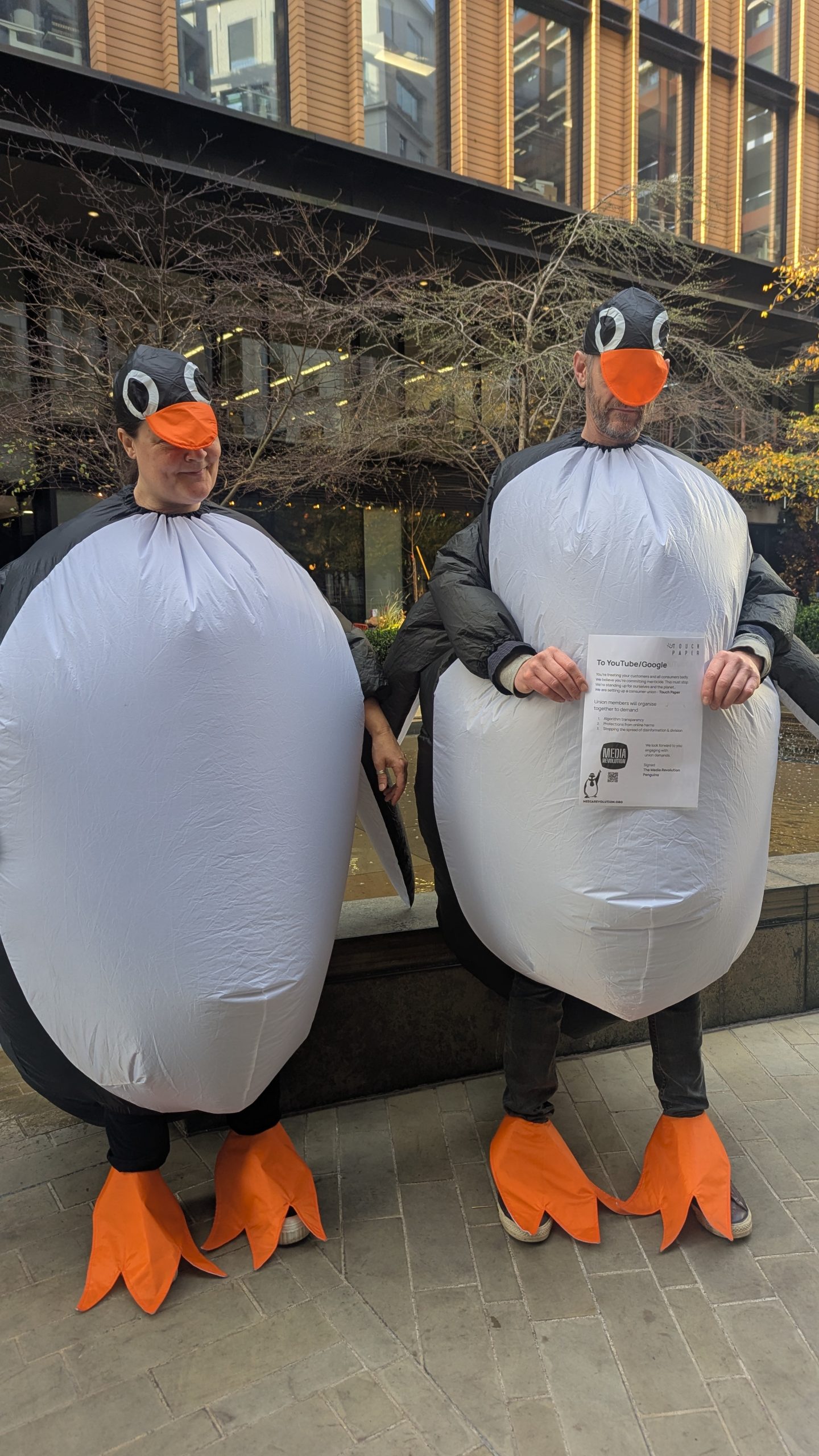
Why are Google and YouTube scared of a hand-delivered letter?!
Is it because they have fishy transparent algorithms? Because they don’t want people or penguins to realise they have the power to organise and demand better?!
On #MediaLiberationDay – activists from #MediaRevolution visited YouTube and Google HQ to highlight they are harming media consumers by promoting #disinformation and #division – and to demand they be transparent about what content they promote and what content they hide as well as mark the beginning of a new media consumer union …. Touch Paper.
The billionaire brainwashing is bonkers but we have the power to demand better. With a member-led consumer union, we can leverage the power of our attention economy – they improve or we go elsewhere. And yes, there are plenty of places to get your search results and videos these days.
Media menticide is the root cause of so many problems around the world. A better world is possible, but it’s being hidden by fishy algorithms. Join at touchpaper.media
POST LINKS
Do us a favour and go like, comment, share and subscribe? Being on socials is
Retail industry warns publishers as Media Revolution gathers pace
London, UK – The retail trade press has issued a warning to publishers following the launch of Media Liberation Day, marking a shift in the balance of power between the public and the press.
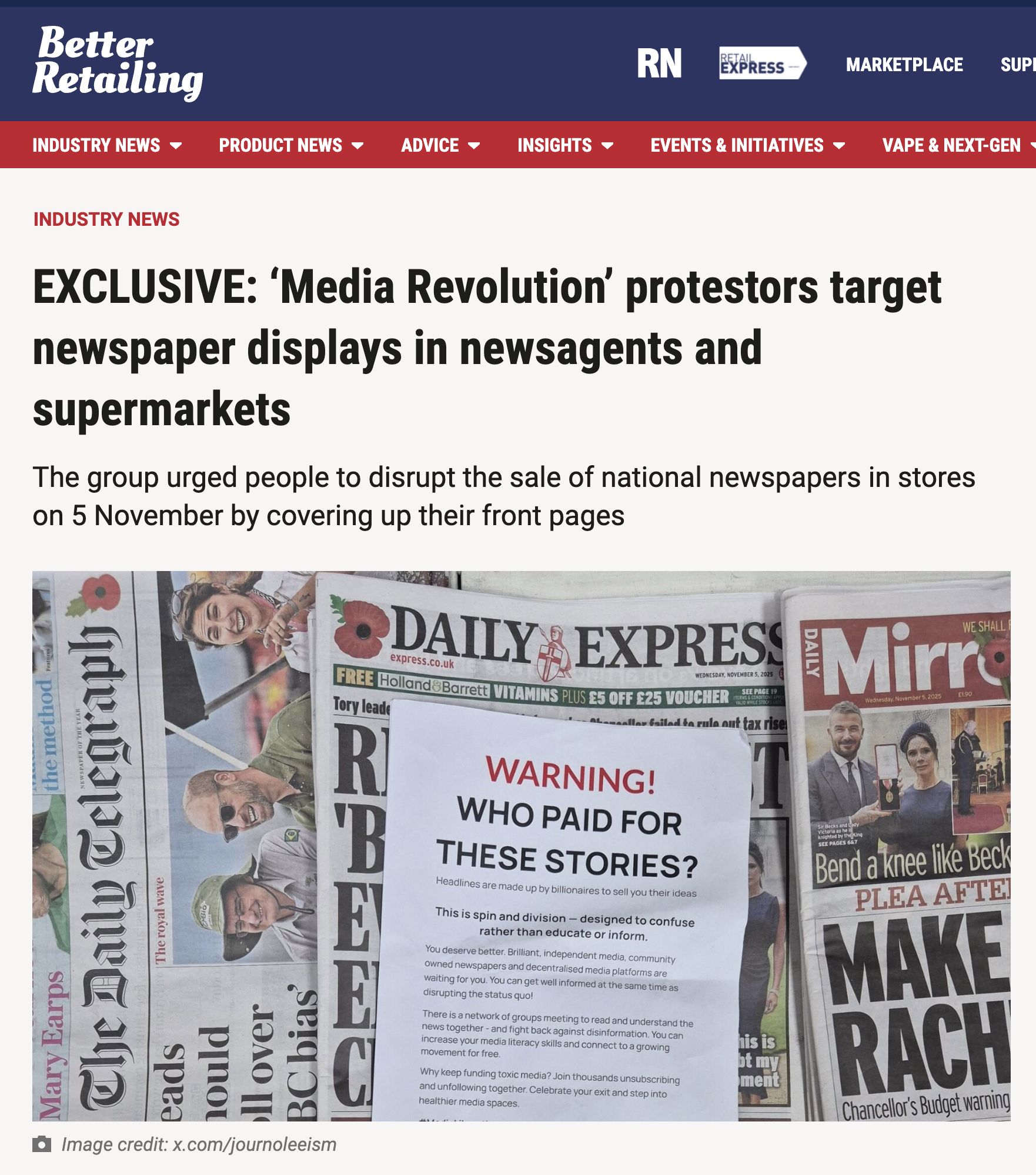
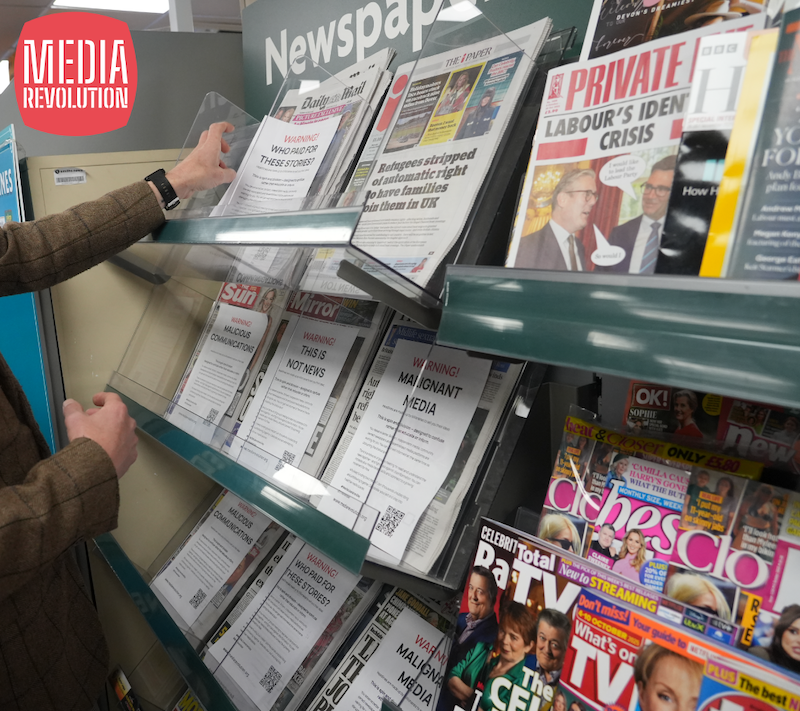
According to Better Retailing, a message circulated to stores by publishers and trade groups advised retailers to “remove blockages” and “exercise extra vigilance to protect sales,” following nationwide actions where supporters placed alternative front pages over harmful media headlines. The coverage marks the first public acknowledgement by the news supply chain that the Media Revolution movement has begun to make its presence felt.
“When the industry itself starts preparing, that’s a sign of real potential,” said Liz Pendleton, co-founder of Media Revolution. “The people have had enough of billionaire brainwashing and are starting to organise for change – and now the system knows it.”
“Without first tackling the media systems, our responses to the genocide, political, social and climate crises will be far less effective,” said Caspar Hughes, co-founder of Media Revolution. “With the media on the side of the people, not their billionaire owners, we will reduce harm to people and planet in the coming decades.”
An awakening within the system
Media Revolution — a growing alliance of independent journalists, technologists, activists and media reformers — launched the first Media Liberation Day on November 5th with coordinated actions across the UK. From inflatable penguin activists delivering letters to Google and YouTube demanding algorithmic transparency, to academic discussions at Exeter University on media accountability, the message was clear: the media status quo is no longer untouchable.
Independent outlets such as Byline Times, The Prisma, and Bylines Network reported on the campaign, amplifying the movement’s central message that access to accurate information is a human right, and that disinformation and division are unacceptable and avoidable.
With the retail supply chain acknowledging its reach, Media Revolution is entering a new phase — building a media consumer union to protect the public’s right to truth and transparency.
“This is just the beginning,” added Pendleton. “The library of tactics — from ‘cover stories’ to collective boycotts organised by Touch Paper — will keep expanding until accountability and consent-based content consumption becomes the norm.”
A growing global call for accountability
The Media Revolution movement continues to grow internationally, with partnerships forming across Europe and grassroots groups joining forces to demand transparency from both legacy media and big tech. The goal: a democratic, accountable, and people-powered media system.
*Menticide is brainwashing. In this instance, billionaire media owner brainwashing. Enough is enough. We need to organise, unionise and change the media.
Blow up this message! It’s an epic plot – and you can be involved.
Access to information is a human right. Our lives depend on making informed decisions based upon facts and trusted data.But right now, we’re living in a total disinformation disaster.
When considering media regulation law, there are huge variations depending on where you are in the world; another problem, considering the media system is a global one.
In countries where newspapers, radio and TV are controlled by the government, media consumers may have some understanding that the ‘facts’ reported will be selective. Some countries allow the news media to say what they like, and some, like the UK – home of the printed press (and Media Revolution), have regulation – but it’s dangerously complicated and inconsistent. No wonder people don’t trust the press.
Many major elements of the lives of people around the world are regulated to ensure safety – healthcare, food, water and transportation to name a few. But what about the content we consume? That which educates, informs and guides us? It’s either dangerously unregulated or incredibly badly regulated.
So what could proper regulation do, who should it protect, who should make the rules and who should enforce them?
Social media, TV and digital outputs take a massive steer from printed press – globally. The fact that newspaper sales are dropping – or news avoidance is on the rise – is a distraction. All that matters is that audience numbers are increasing – the print propaganda has simply shifted online, into social and digital accounts owned by the same few billionaires globally – then amplified by the algorithms of their tech-bro chums.
The UK has a disproportionate amount of global media power which it wields incredibly recklessly. This is the legacy of the printed press. For that reason, we will talk here about UK press regulation as a starting point for a global change on wider media regulation as a whole.
A media revolution for regulation would be based on principles of transparency and open access to accurate information. Journalists and publishers should have the right to seek out the truth, but be held to a code of conduct that protects the public from intrusion and abuse – and crucially, the media owners themselves must be held accountable for misrepresentation and disinformation.
For this to happen, regulation must be independent from media owners and editorial managers, as well as free of government influence.
In countries run by authoritarian regimes, press regulation means heavy-handed and punitive censorship. Journalists face surveillance, harassment, jail or murder for simply trying to report the facts. The media is deployed as a weapon of oppression, restricting access to any information that challenges or criticises those in power. Censorship of digital expression is increasing at an alarming rate – all around the world, not just in countries with reputations for oppressive state control.
Coming back to the UK regulatory system – which other countries might look to as an example – the newspaper regulator is not the government itself, but the Independent Press Standards Organisation (IPSO). Sounds good so far. However, due to the power, influence and known corruption of the press, IPSO isn’t actually independent at all. It has been described as a sham regulator – actually set up by the owners of the biggest national and international news groups, who continue to fund and run it.
IPSO has an Editors’ Code of Practice, drawn up by newspaper editors, and is meant to be the first port of call for complaints about inaccurate or intrusive reporting from the public. But the shocking situation is that despite thousands of complaints, in 1 1 years of operating it has never fined a single publication or opened any investigations into their coverage.
The Press Recognition Panel (PRP)– which oversees press regulation in the UK – said: “IPSO is not a regulator… it does not provide the public with the necessary levels of protection … it is a trade complaint handling body with no independent oversight”, one that shifts “the burden of investigation on to complainants.”
None of the national papers are members of the regulatory body approved by the PRP. Remarkably, a truly independent regulator – Impress, approved by the PRP – operates by an independent code of conduct and has a membership of more than 200 smaller local publications and independent online news outlets, but the nationals ignore it.
Self-regulation by these globally influential newspaper owners effectively means they’re free to publish inaccurate reports that favour their owners’ financial and political interests. This is why most of the UK’s national press (remember, they are a major source for social media and global news) has completely downplayed, dismissed or ignored one of the biggest threats to humanity – if not the biggest – the climate emergency. Media owners and backers have strong links with right-wing think tanks funded by fossil fuel giants. Impress has warned of deliberate climate disinformation by publishers and lobby groups that exploit the absence of regulatory oversight to distort public opinion and delay policy action.
In its report Climate News and Independent Regulation, Impress said: “Access to reliable information via quality journalism is a cornerstone of democracy … As the climate crisis accelerates, ensuring this access is vital.”
TV and radio broadcast regulation in the UK is also failing the public. The global news provider BBC, which is consumed in around 200 countries/territories around the world, has been accused by many – including some of its own presenters – of shaping news coverage to suit government and corporate agendas and giving unfair prominence to favoured politicians or ideologies while under-representing other parties and ideas.
To add confusion, TV and radio are regulated separately by Ofcom, who have such a light touch that TV channels including climate change deniers like GB news are allowed to broadcast news dressed up as current affairs shows, hosted by right-wing politicians, funded by big oil. The channel has also been described as ‘a central hub for climate scepticism’ by the Institute for Strategic Dialogue.
All of this is a disaster for public confidence and access to accurate information.
For years, climate scientists and concerned citizens have flagged the dangers of media falsehoods – only to watch complaints vanish into a regulatory void. The result has been delayed climate action, eroded democracy and a public left unsure who or what to trust.
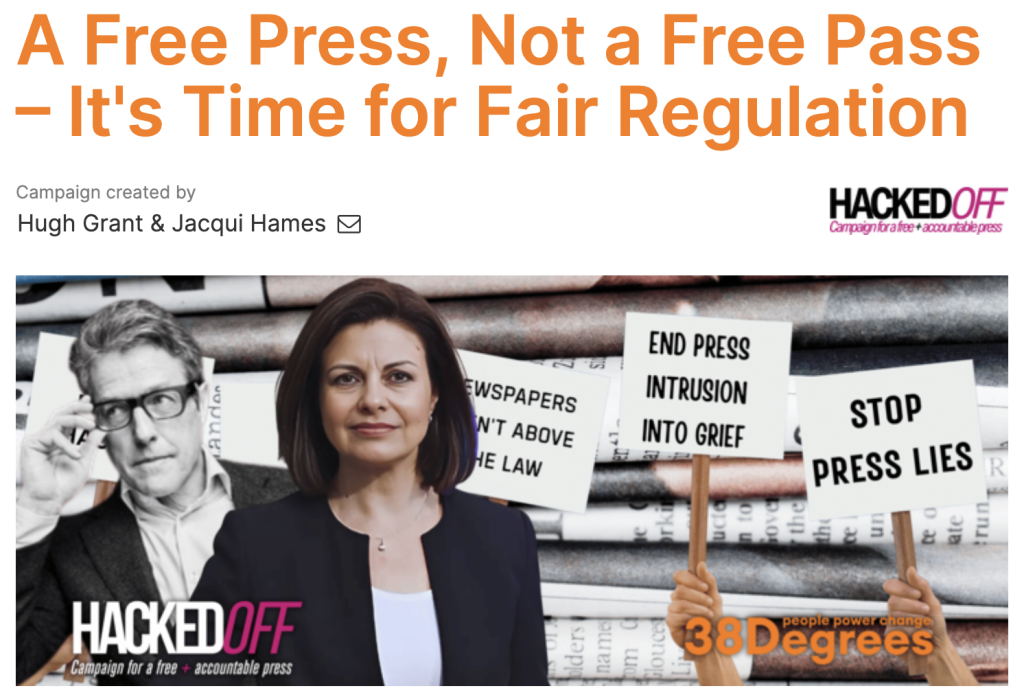
So what can be done? The campaign group Hacked Off – a team of experts in press malpractice and abuse – was set up after the phone hacking scandal that rocked the UK when criminal activities by The News of The World were exposed. It is now calling for new legislation to protect people from press abuse, to protect press freedom, and build in both accountability and accuracy. Its latest campaign for a proposed Better Media Bill is gathering popularity from the public, press abuse victims, celebrities and politicians alike. This could be a monumental improvement to the regulatory landscape – not just in the UK – but one that could send a ripple of responsibility out into the wider world, setting a benchmark of regulation that is desperately needed worldwide.
Protecting people at the point of consumption must go hand in hand with tackling the upstream causes of harm. Real change needs independent oversight with the power to act when outlets mislead, as well as new ownership and funding models that will free journalism from billionaire and fossil fuel capture. Grassroots pressure from scientists, campaigners and communities demanding truth must be heard – and while all that is happening, we also need to grow media literacy so that audiences can spot manipulation, divest from the attention economy and protect themselves from harm – pushing back with consumer rights, where regulation fails.
No single fix can stem the tide of disinformation – but coordinated action can. That’s why Media Revolution aims to cooperatively build a movement that unites regulation, replacement, the crucial element of civil resistance and public empowerment into one coherent force.
The complaints – whether about disinformation, division or press intrusion – have been mounting up, and ignored long enough. It’s time to turn that frustration into power and to demand a media regulation system that protects both people and planet.
Fancy tackling the billionaire disinformation system?! 🤑 🤑 🤑
Take part in #CoverStory on Media Liberation Day – 5th November to direct people to independent, well regulated media and socials with no ads, algorithms or billionaire owners.
It’s time to divest our attention economy. It’s time to say #ByeByeMenticide
Support this by sharing any of these posts on your preferred platform!
For most of human history, meat was a luxury, a ritual or an occasional indulgence. It is only in the 20th and 21st centuries, with industrial farming, mass subsidies, global supply chains, and changing diets, that eating meat daily has become seen as normal. Along with this dietary shift came spikes in chronic disease — heart disease, type 2 diabetes, some cancers — linked to high animal-product consumption. As well as increasing health risks, the change hastened ecological collapse, climate emissions and biodiversity loss.
For some or all of these reasons, many people are turning towards a plant-based diet – and food retailers are responding.
In a global survey by The Vegan Society and others, in 2021, 88% of food industry practitioners expected demand for plant-based products to increase; 74% believed consumers were choosing plant-based largely for health, 60% for environmental reasons. That suggests the shift is already baked into supply-chain expectations.
According to a recent global report, in 2024 the vegan food market had an estimated size of USD 56.99 billion, and it is projected to grow to USD 108.55 billion by 2029 — a compound annual growth rate of about 14.1%. This isn’t niche shelf-space in health food shops: the Business Research Company’s 2025 Global Market Report on plant-based food indicated that supermarkets, hypermarkets, and mass retailers are expanding their vegan offerings everywhere, from Asia-Pacific to Latin America, from North America to Europe.
These numbers reveal something important: the shift isn’t about force or guilt-tripping. It’s about people choosing differently, in their millions. Consumer demand is pushing retailers to respond; plant-based options are no longer marginal.
But with rising demand comes rising pushback — often from media outlets that frame this change as alarming or morally confusing. Several academic studies show that vegans, vegan diets, or campaigns to reduce animal product consumption are framed in ways that discourage empathy or rational debate — instead emphasising extremes, ridicule or cultural conflict.
A qualitative study in Denmark (2023-24) analysed major Danish newspapers and found that veganism is routinely framed in binary oppositions: advocates vs extremists; modern ethics vs traditional culture. This frame marginalises moral voices and presents vegan ethics as “outside the norm,” odd, or radical.
A study in the US found that labels “vegan” or “vegetarian” can cause negative bias: some consumers avoid labelled items even when the food is identical, purely based on prejudice or preconception. Media stories that emphasise “risk”, “deficiency”, or “extreme health claims” fuel those preconceptions.
Why this matters: Demand, Denial, Decision
So: the demand is here. People are choosing differently. Retailers are responding. Global markets are growing fast. But much of the mainstream press acts as if this were a threat rather than a reflection of public values shifting. Why?
Because moral discomfort is inconvenient. It forces reflection on what we eat, how we live, and how industries operate.
Because industries (meat, dairy, animal agriculture) have power, profit, and political influence — they benefit when the story continues to be about the “radical few”, not systemic cruelty.
Because framing matters: if the public hears “vegans are extreme”, “plant-based diets are risky”’ “meat culture under attack”, many are deterred, confused, or turned off before they even consider the facts.
Toward honest conversation and incremental change
Change doesn’t need to be total overnight. But it begins when what is normal is questioned. When supermarkets make vegan options prominent. When people try plant-based eating without shame or disbelief. When press coverage acknowledges data — that millions participate in Veganuary, that industry expects rising demand, that markets show this.
By reducing consumption — even modestly — people can shift habits. By speaking truth about what animal industrialisation really costs (morally, environmentally, health-wise), we can demand better.
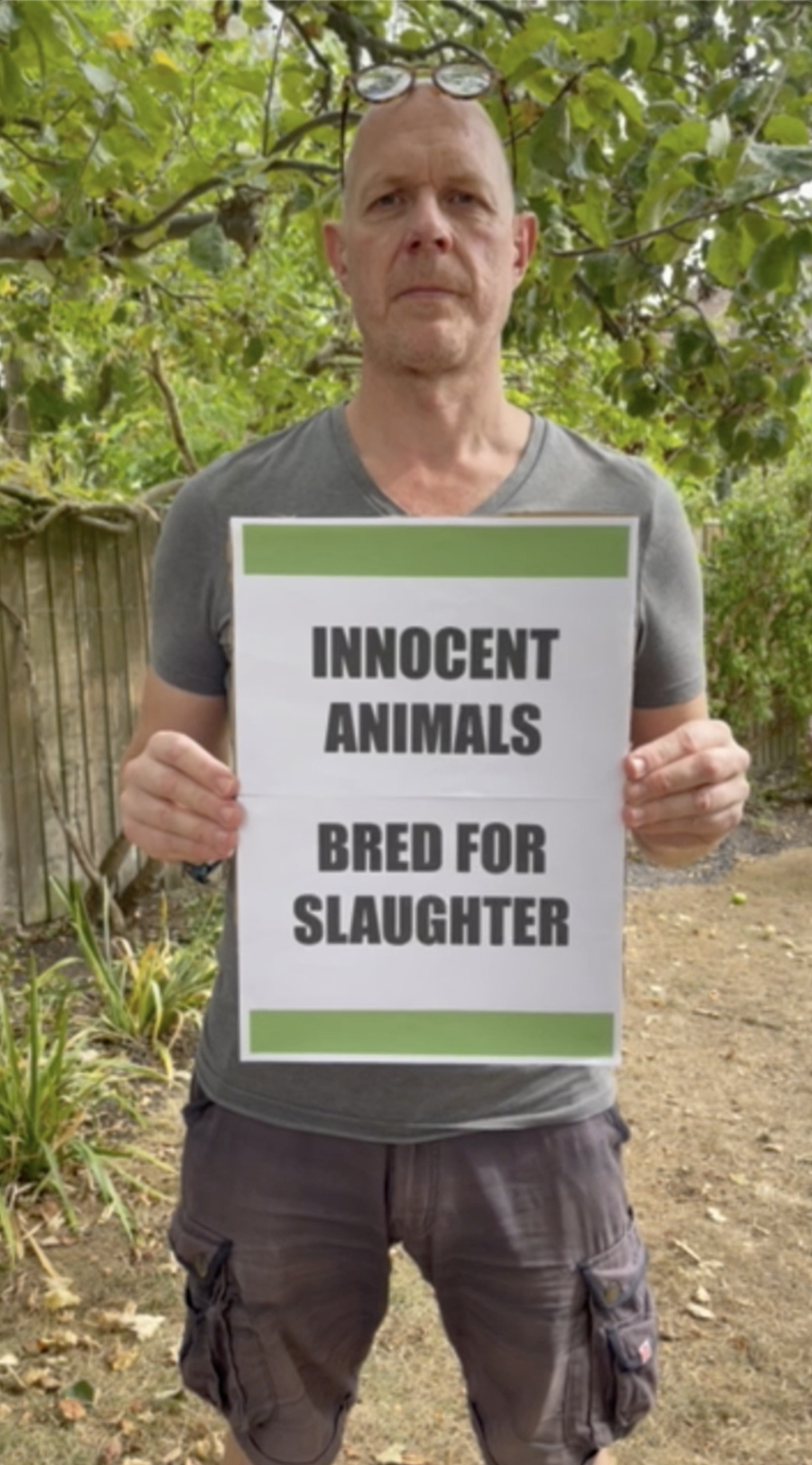
Vegans are often accused of preaching extreme moral values. But what’s truly extreme is the media attitude to billions of animals being bred for slaughter; ecosystems stressed; human health compromised.
The media can’t credibly act as though veganism is fringe when markets, surveys, and millions of people say it isn’t. Compassion isn’t preachy. Silence in the face of suffering is.
“Absurd Intelligence is convening and catalysing an unrivalled network of world-class interdisciplinary experts, with the intention of driving much-needed Narrative and Movement Leadership.
Our ambition is threefold:
To create a mass arts and culture movement that unites us in a desire to build a better world than the one currently on offer.
Rebalancing the polarities of what it means to live together, polarities that have been massively upended, weaponised and bent out of shape by those who profit from driving us apart.
A revitalisation of our democracy by putting our trust in people, building a new political culture for a better, kinder, freer world.“